Paris Red will be published by W. W. Norton in the U.S. in April 2015. Right now that seems like a long wait, but I know it isn’t, not in the world of publishing. In one very important way, it is also an ideal time for the book to come out because Spring 2015 marks […]
I haven’t blogged for several weeks because I’ve been busy working on the final editorial changes to Paris Red. In a couple of instances, I had to examine the key relationships in the book and bring a little more clarity to them, and to do that, I had to go deeply back into the novel. I […]

Researching Paris Red, I read widely about subjects directly and tangentially related to Victorine Meurent and Édouard Manet. Susan Chitty’s book about English artist Gwen John was both helpful and beautifully written. And let me declare here that almost everything I know about Gwen John I learned from Chitty’s Gwen John: 1876-1939. Before I read this […]

Last week I wrote about how Marville’s old photographs of Paris allowed me to enter Victorine’s world. I needed that gift from the past, the history provided by Marville. But the flow goes both ways: there are some things of mine, from the present, that I gave to Victorine. It’s what novelists do: we give pieces […]

I don’t know if I would have been able to write the story of Victorine Meurent without the work of another artist—and I don’t just mean Manet, the man who painted her over and over. I mean that without the photos of Charles Marville, or Charles François Bossu, I would have had much more difficulty imagining […]

Victorine Meurent is best known as Manet’s famous model, but she was also an artist. She exhibited work at the Académie des Beaux-Arts, but the only painting of hers that is known to exist today is the work above, Le jour des rameaux, or Palm Sunday. That simple paragraph might not seem to contain revolutionary […]

The photograph above was taken by Félix-Jacques Antoine Moulin in 1852 and is in the Bibliothèque Nationale de France (BNF). Art historian Beatrice Farwell believes the woman in the photo is Manet’s model, Victorine Meurent. Here’s another of Moulin’s photos of the woman Farwell believes is Meurent: In Farwell’s 1981 dissertation Manet and the Nude, a Study in […]
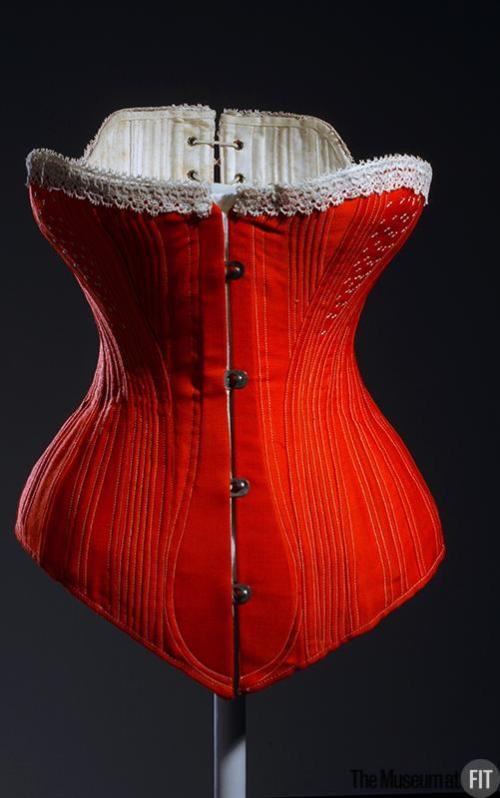
Above, corset from the Metropolitan Museum at FIT. Red wool, silk, steel and whalebone, circa 1880. So, not strictly from Victorine’s time of posing for Manet, but close.
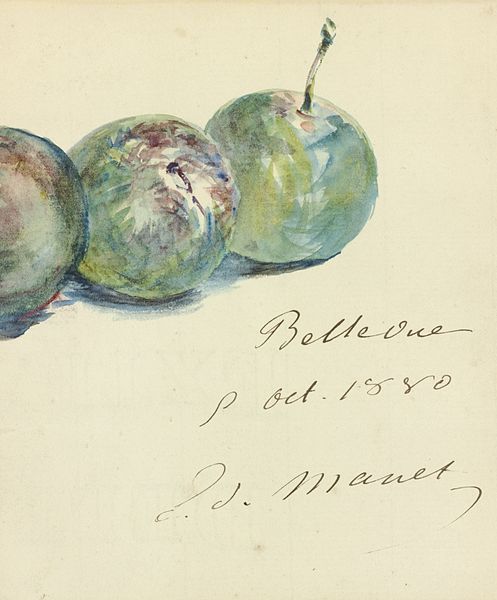
Manet inspires me for many reasons, but I’ll focus on just one in this love letter. Almost as soon as Manet started to paint, people criticized his choice of subjects, use of color, composition, or style of painting. One of his first critics was his teacher, Thomas Couture, who objected to Manet’s desire to portray […]
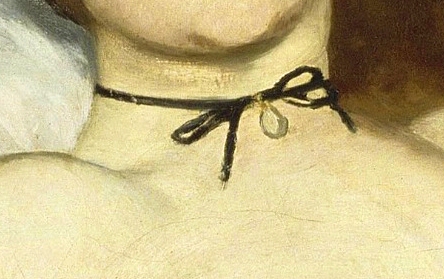
Today I’m thinking of the black necklaces Manet often painted women wearing. Maybe many women did wear chokers. But I think Manet painted black ribbon necklaces in so many of his portraits because the strip of black against skin added something essential to his compositions—and just because he liked the way it looked. He made black chokers […]
 Paris Red: A Novel by Maureen Gibbon